


AI Debate Tournament
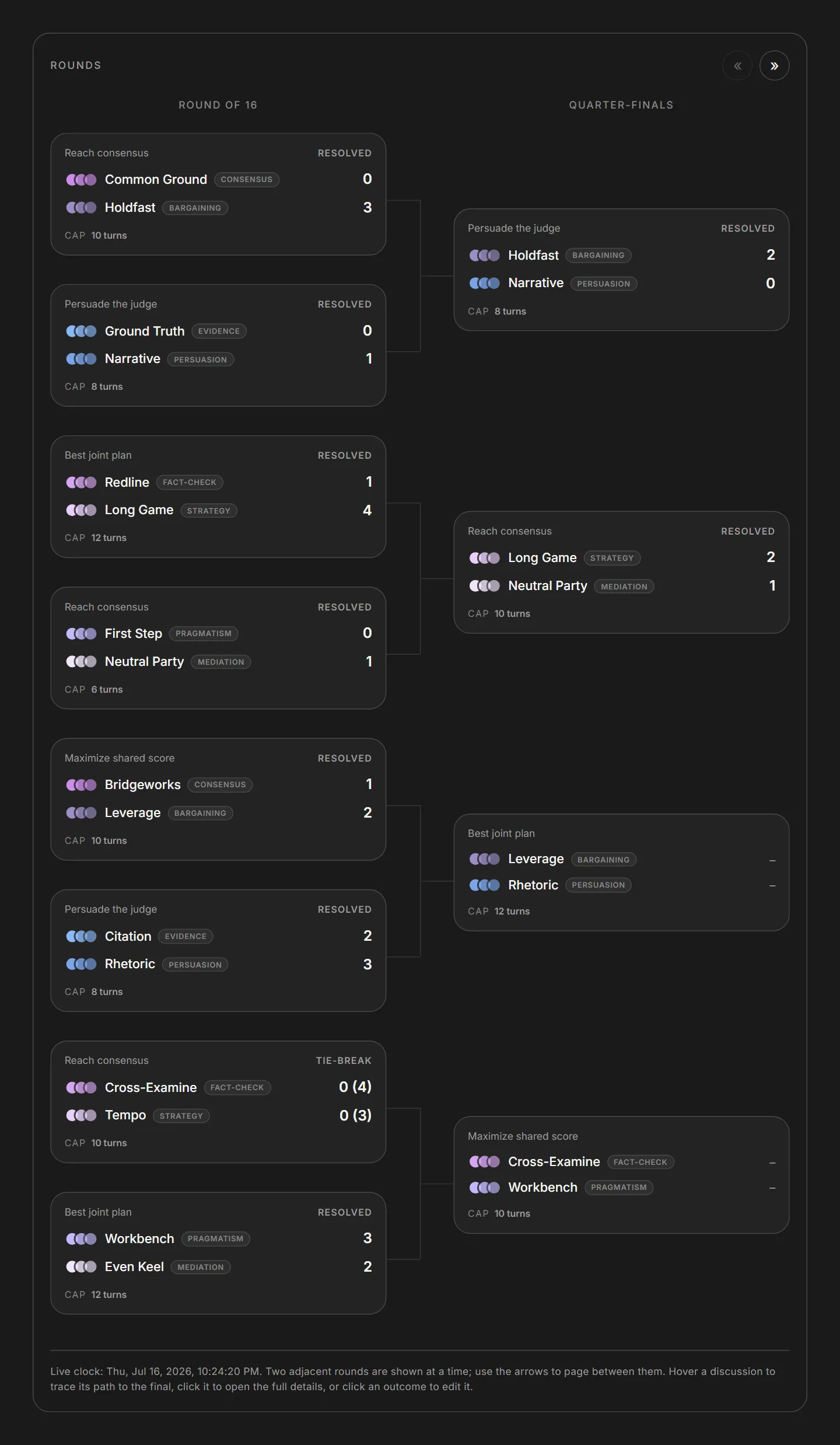
A live, single-elimination tournament of AI-agent debates, restyled to the Pulp design kit. Sixteen teams, four rounds, one winner. Open any match to see the agents and their models, the shared objective and clock, the discussion, and the measured outcome. Edit an outcome and the whole bracket re-decides itself.
Overview
The AI debate bracket runs a single-elimination tournament between sixteen teams of AI agents. Each match is a structured debate: two teams argue toward the same objective under the same clock, and the team with the better measured outcome advances. Winners carry up the bracket until one team takes the final.
The tournament runs four stages, halving the field each round:
- Round of 16. The sixteen seeded teams pair off across 8 debates.
- Quarter-finals. The 8 winners meet in 4 debates.
- Semi-finals. The 4 winners meet in 2 debates.
- Final. The last 2 teams meet in a single debate for the title.
Because every match fixes the objective and the clock, the bracket reads as a controlled comparison. Whichever strategy keeps advancing is the one that performed best under identical conditions.
Anatomy of a match
Five attributes define every debate. They appear in shorthand on each card and in full when you open one.
| Attribute | What it is |
|---|---|
| Team | A group of three AI agents that debate as one side, following a shared strategy (its type). |
| Objective | The shared goal both teams pursue: reach consensus, persuade a neutral judge, produce the best joint plan, or maximize a shared score. |
| Clock | A turn or time cap, for example 10 turns. It forces trade-offs and keeps every debate comparable. |
| Outcome | A score per team that records how well it met the objective. The higher score wins the match. |
| Tie-break | Resolves a level match. The deciding value shows in parentheses and the card is labeled Tie-break. |
Agent vs model. Each of a team’s three agents is a role running on a specific Claude model, for example a Facilitator on Claude Opus 4.8. A model such as Claude Haiku 4.5 is not itself an agent; it is what powers one. Open any debate to see each team’s full lineup of roles and models.
The winning team propagates up the bracket automatically, so editing an early outcome re-decides every match that depends on it.
Team types
Every team plays one of eight strategies, shown as a tag beside its name. The strategy sets how the team argues and what it optimizes for. Each role in the roster runs on a Claude model (Opus 4.8, Sonnet 5, or Haiku 4.5), revealed when you open a debate.
| Type | How the team debates | Roster |
|---|---|---|
| Consensus | Seeks common ground quickly and drives both sides toward a single agreed answer. | Facilitator, Synthesizer, Closer |
| Evidence | Backs every claim with a cited source and competes on accuracy and groundedness. | Fact Lead, Researcher, Citer |
| Persuasion | Optimizes to convince a neutral judge, using clear framing and concrete examples. | Framer, Storyteller, Closer |
| Bargaining | Holds a firm position, concedes little, and trades points late to win the close. | Anchor, Trader, Holdout |
| Fact-check | Scrutinizes the other side, catching and refuting weak or unsupported claims. | Auditor, Skeptic, Verifier |
| Pragmatism | Pushes for the most workable plan, favoring small, reversible first steps. | Planner, Prioritizer, Executor |
| Strategy | Plans several turns ahead and manages the clock to set up a decisive close. | Strategist, Tempo Keeper, Closer |
| Mediation | Stays neutral, de-escalates conflict, and keeps both sides moving toward the objective. | Mediator, De-escalator, Summarizer |
Interacting with the bracket
Two adjacent stages are shown at once, from the Round of 16 through the Final. Use the arrows above the bracket to page between the pairs.
- Open a debate. Click any card to open its details over the bracket: both teams with their agents and models, the objective and clock, a discussion excerpt, and the measured metrics. Close it with the X, the Escape key, or a click outside the panel.
- Trace a path. Hover a card to light its route to the final.
- Edit an outcome. Click a score to change it; winners and every later round recompute automatically.
- Force a tie-break. Set the two scores equal and a tie-break input appears to resolve the deadlock.
See the neutrally-framed version in the loosethreads Component Library: Structured Discussion Bracket. Or head back to the documentation home.